
Record-breaking 7.3 Tbps distributed denial-of-service (DDoS) attack sets a new benchmark for the scale and intensity of hyper-volumetric attacks.

Record-breaking 7.3 Tbps distributed denial-of-service (DDoS) attack sets a new benchmark for the scale and intensity of hyper-volumetric attacks.

In a concerning escalation of cyber threat activity, a record-breaking distributed denial-of-service (DDoS) attack peaking at 7.3 terabits per second (Tbps) was recently mitigated, setting a new benchmark for the scale and intensity of hyper-volumetric attacks. This unprecedented surge, observed and neutralized by global cybersecurity firm Cloudflare, underscores the rapidly evolving threat landscape facing global infrastructure providers, telecommunications networks, and digital platforms.
Researchers identify new ransomware-as-a-service (RaaS) Global Group believed to be rebrand of now-defunct BlackLock RaaS with new AI-powered chatbots.

Researchers identify new ransomware-as-a-service (RaaS) Global Group believed to be rebrand of now-defunct BlackLock RaaS with new AI-powered chatbots.

Cybersecurity researchers have identified a new ransomware-as-a-service (RaaS) operation known as GLOBAL GROUP, which has rapidly expanded its targeting capabilities across multiple critical sectors. Since its emergence in June 2025, the group has launched attacks on organizations in Australia, Brazil, Europe, and the United States, posing a significant threat to global cybersecurity.
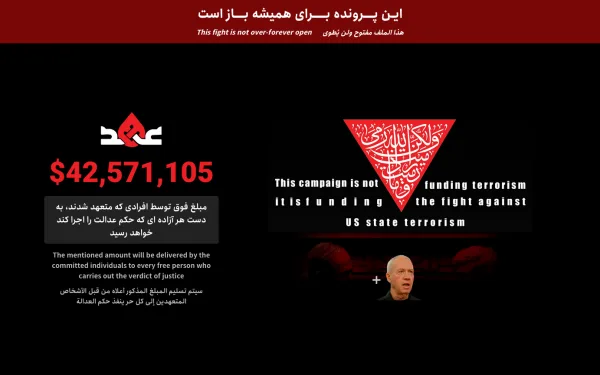
Iranian-sponsored fatwa crowdfunding campaign to assassinate Donald Trump surpasses $42 million and continues to grow. Here’s what we know about the thaar.ir WordPress website that is hosting it.

Iranian-sponsored fatwa crowdfunding campaign to assassinate Donald Trump surpasses $42 million and continues to grow. Here’s what we know about the thaar.ir WordPress website that is hosting it.

An Iranian-sponsored crowdfunding campaign continues to grow, aiming to raise funds for the assassination of U.S. President Donald Trump. This campaign is primarily linked to hardline Iranian clerics and groups, and has gained significant attention due to its scale and explicit purpose.
MITRE introduces AADAPT, a new framework to address vulnerabilities in digital financial and cryptocurrency platforms.

MITRE introduces AADAPT, a new framework to address vulnerabilities in digital financial and cryptocurrency platforms.

MITRE has introduced AADAPT (Adversarial Actions in Digital Asset Payment Technologies), a new cybersecurity framework specifically designed to address vulnerabilities in digital financial ecosystems, including cryptocurrency platforms. AADAPT aims to provide a structured methodology for identifying, analyzing, and mitigating risks associated with digital asset payment technologies such as cryptocurrencies, consensus algorithms, and smart contracts.
Study finds organizations are deploying AI at record speed while their security and governance frameworks lag behind.

Study finds organizations are deploying AI at record speed while their security and governance frameworks lag behind.

As artificial intelligence (AI) becomes an integral part of modern business operations, a new report from F5 highlights a growing concern: organizations are deploying AI at record speed, but their security and governance frameworks are struggling to keep up. The 2025 State of AI Application Strategy Report reveals critical gaps in preparedness that could leave enterprises vulnerable as they accelerate their AI initiatives.
CISA warns of a cyberattacker’s ability to derail a train by engaging emergency brakes through software-defined radio (SDR).

CISA warns of a cyberattacker’s ability to derail a train by engaging emergency brakes through software-defined radio (SDR).

A significant cybersecurity vulnerability affecting the United States rail network has recently come to light, revealing that trains can be remotely forced to engage emergency brakes through the use of inexpensive software-defined radio (SDR) equipment. This flaw, which poses serious safety and operational risks, has been known to security researcher Neil Smith since 2012, but only gained widespread attention following a formal advisory issued by the Cybersecurity and Infrastructure Security Agency (CISA) in 2025.
CISA adds Wing FTP Server vulnerability to the Known Exploited Vulnerabilities (KEV) catalog.

CISA adds Wing FTP Server vulnerability to the Known Exploited Vulnerabilities (KEV) catalog.

The U.S. Cybersecurity and Infrastructure Security Agency (CISA) has officially added a new critical vulnerability, CVE-2025-47812, affecting Wing FTP Server, to its Known Exploited Vulnerabilities (KEV) Catalog. This action follows confirmed reports of active exploitation in the wild, underscoring the urgent need for organizations to address this security risk immediately.
Computer hacker holding up a bitcoin

Cyberattacker targets VSCode’s Cursor IDE via a fake Solidity language extension to steal $500k in crypto from a blockchain developer.

A sophisticated cyberattack targeted the Cursor IDE—a Visual Studio Code (VSCode) fork popular among developers for its AI-assisted coding features. Attackers published a fake extension called "Solidity Language" in the Open VSX extension marketplace, masquerading as a tool for Ethereum smart contract development. This extension was, in reality, a vehicle for malware distribution and remote access.
Computer hacker holding up cash

Interlock ransomware group has developed a new PHP-based remote access trojan (RAT) designed to evade detection.

Security researchers from The DFIR Report, in collaboration with Proofpoint, have identified a significant new campaign by the Interlock ransomware group. The threat actors are leveraging a newly developed remote access trojan (RAT) to target organizations across multiple sectors, marking a notable evolution in their tactics and tooling.